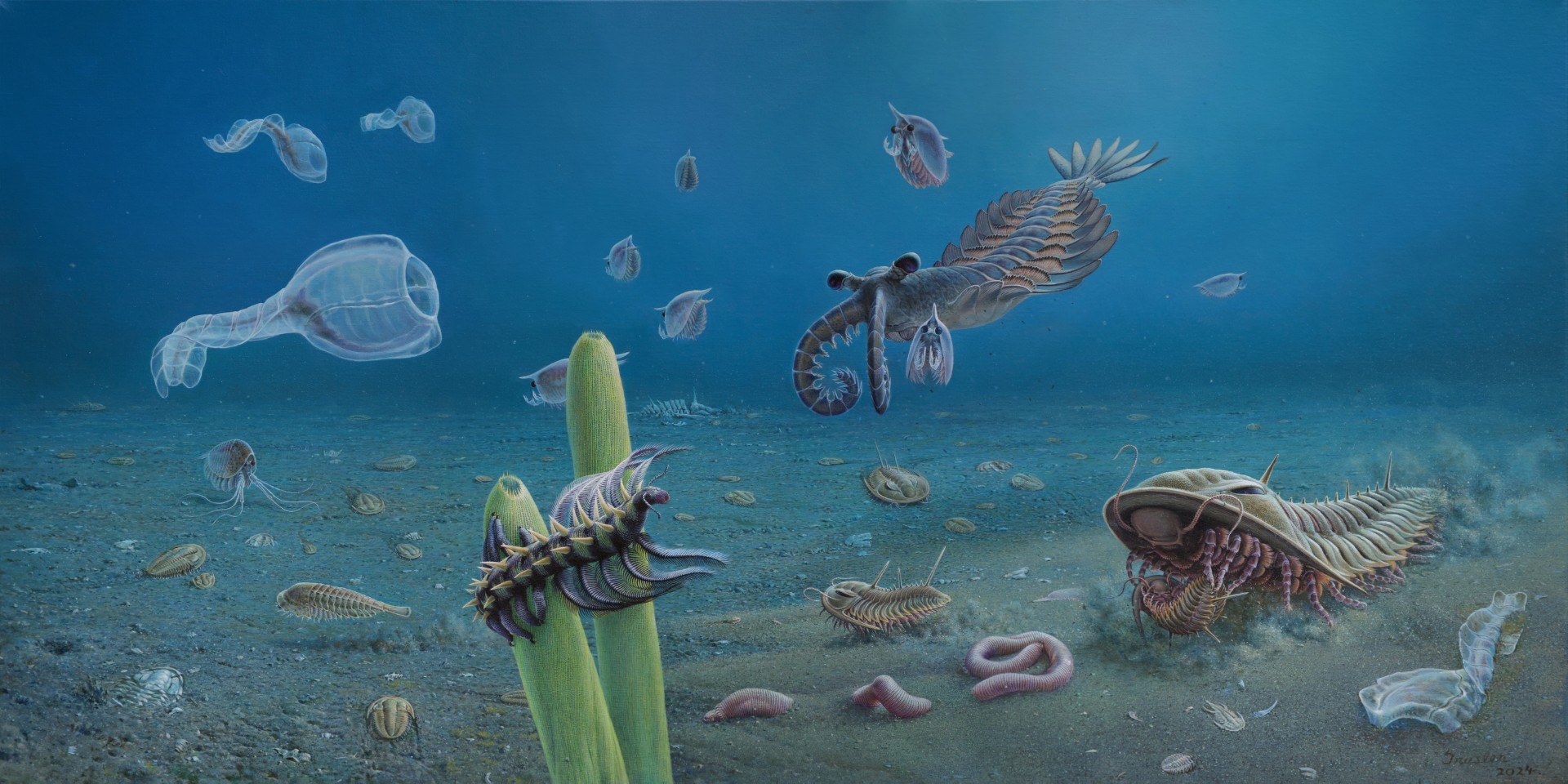
A chance meeting between two science luminaries has delivered a series of beautiful scientific illustrations celebrating one of South Australia’s most significant fossil deposits.
The artwork featuring the amazing 512-million-year-old fossils of the Emu Bay Shale on Kangaroo Island, is the subject of a new free display at the South Australian Museum.
The painting is also the source material for a collector series of stamps, released by Australia Post titled Creatures of the Palaeozoic.
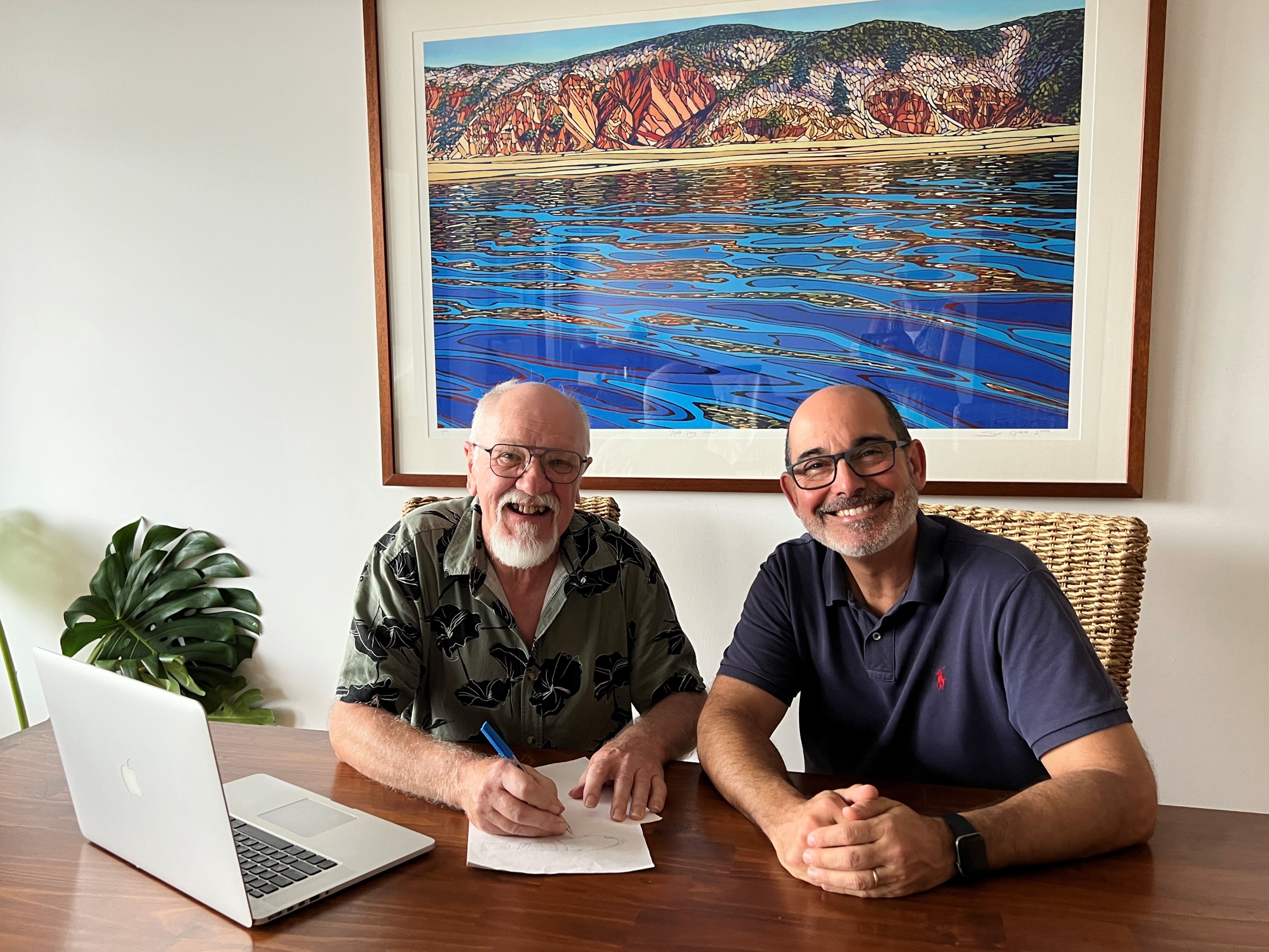
The project came about when Museum palaeontologist and Adelaide University Associate Professor Diego Garcia-Bellido met renowned scientific illustrator Peter Trusler while presenting at a Royal Society of South Australia evening event.
Peter had previously illustrated another set of stamps Creatures of the Slime based on the Ediacaran fossils in the Flinders Ranges and the work of Diego’s predecessor at the Museum, Dr Jim Gehling.
Diego was using the artwork during his lecture when, during the Q&A session, Peter introduced himself.
“He raised his hand and said he had painted the picture I had been using to illustrate the Ediacara Biota,” Diego said. “I thought, oh my God, I’m finally meeting Peter Trusler in person.”
“Peter said Australia Post had commissioned a series on Palaeozoic fossils, and I said hands down it’s got to be the Emu Bay Shale.”

Peter, who lives in Melbourne but lectures on scientific illustration at Flinders University in Adelaide, took the next year or so preparing the artwork.
That resulted in a 1m-long oil painting (top) of 12 creatures found in the Emu Bay Shale, four of which were selected as stamps.
“I’ve found over my career that people really love collecting these tiny (stamp) images,” he said. “I don’t have a strong background on invertebrates, so my learning curve was fairly steep.”
Peter has a long history of working with Australia Post, starting with his Australia’s Age of Dinosaurs series, which serendipitously came out the same year as the blockbuster Jurassic Park in 1993, so became a huge success.
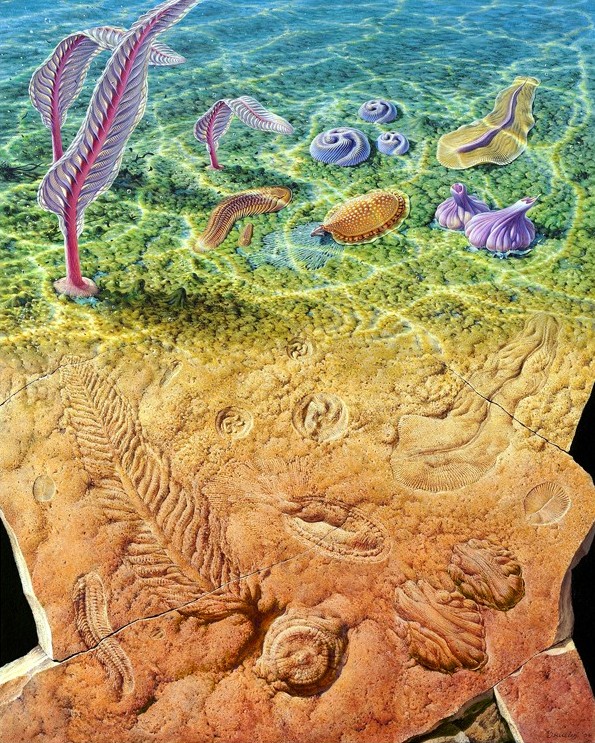
He followed that up with Creatures of the Slime in 2005, a Megafauna series in 2008 and Australian Dinosaurs in 2022.
“That first dinosaur issue encouraged us to look for other opportunities,” Peter said. “I’ve had my eyes on the significance of the Emu Bay site for some time.”
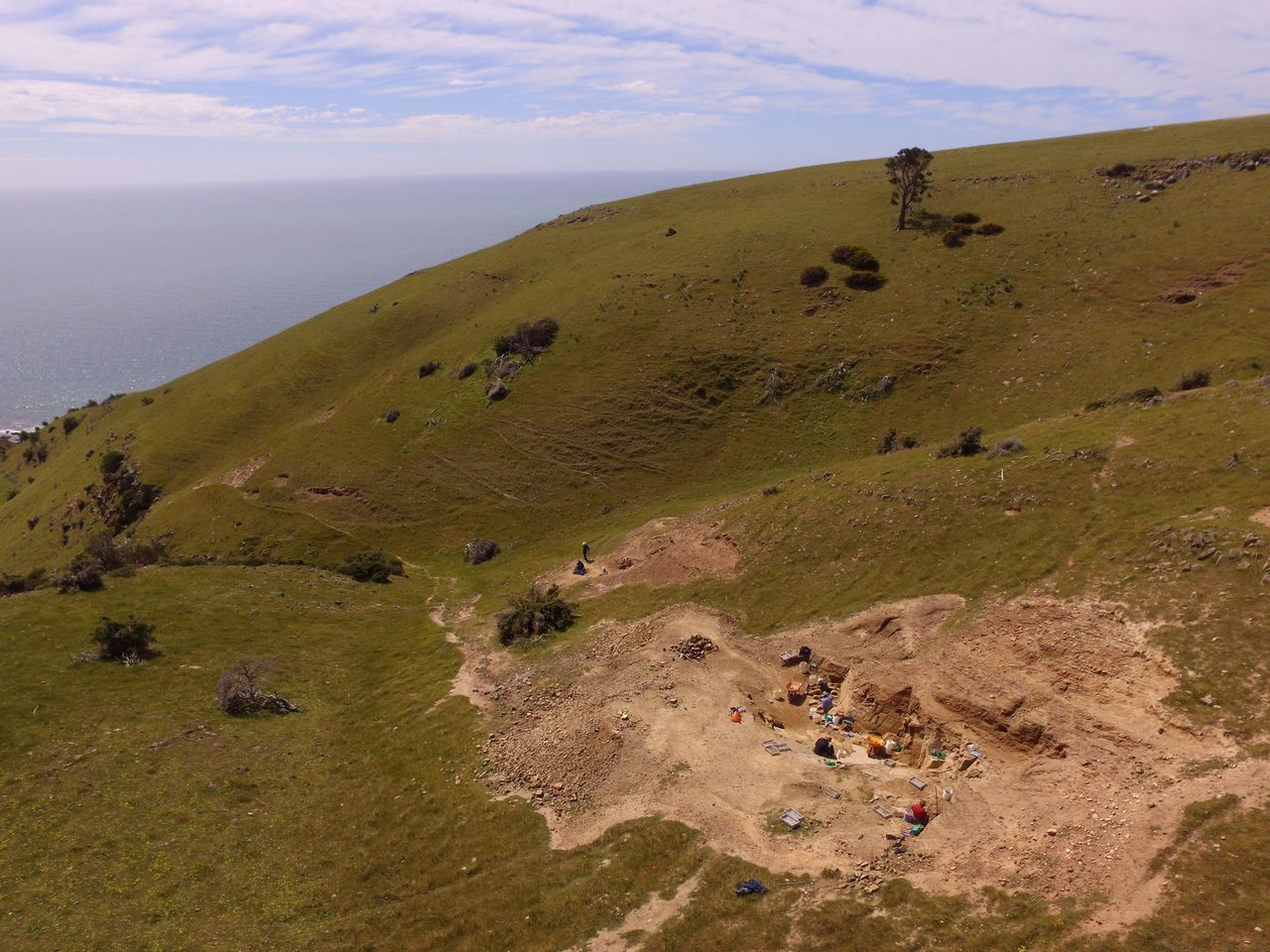
The Emu Bay Shale formation was discovered by South Australian scientist Reg Sprigg in the 1950s – the same person the Museum’s regular Sprigg Salons are named after, and who discovered the Ediacara Biota inthe Flinders Ranges.
The deposit has been the subject of intense research by the Museum in partnership with Adelaide University and the University of New England, Armidale, since 2007.
The fossils in the shale lived in the Palaeozoic Era during the Cambrian Period, which is known for the largest radiation of animals in our planet’s history: the Cambrian “explosion”.
The animals that emerged in a shallow sea during this time were the ancestors of modern sponges, bristle-worms, snails and cockles, crustaceans like crabs and prawns, as well as sea-stars and sea-urchins.
The group which humans belong to, known as chordates because they have a notochord (which evolved into our backbone), also arose during thistime.
The four animals featured in the stamps are Nesonektris aldridgei, Anomalocaris daleyae, Redlichia rex and a spiny lobopodian known as the Emu Bay Shale Monster.
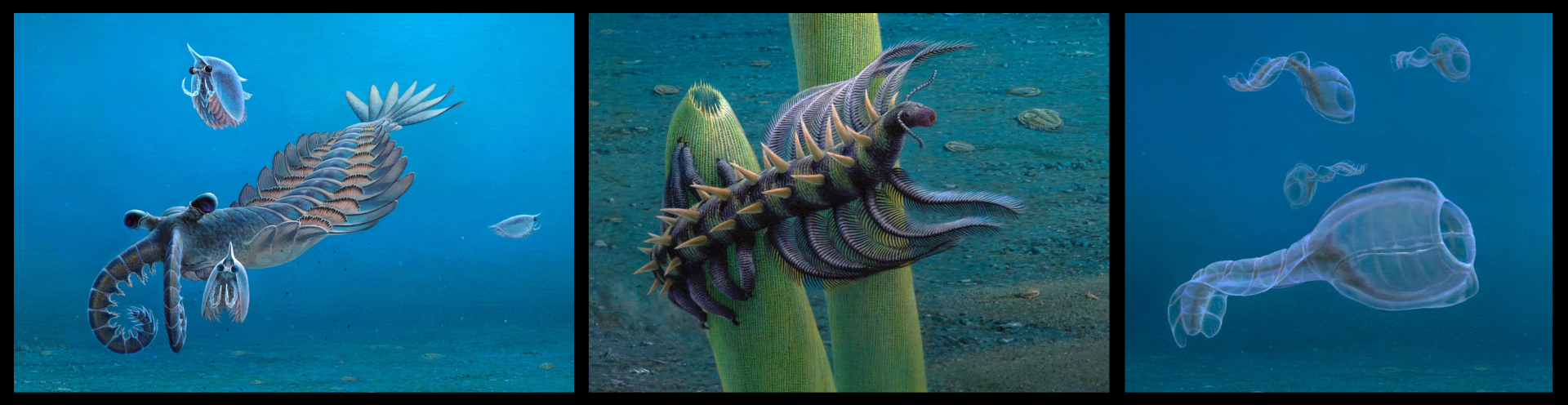
“There has been a lot of work done to identify what the animals fossilised at Emu Bay actually looked like,” Diego said. “Obviously, we don’t know the colours so there’s a fair bit of artistic licence, but the images produced by Peter are as accurate as we can make them in 2026.
“I sent him all our research papers, and he started coming back to me with these incredible recreations. He’s so good.”
Kangaroo Island’s Emu Bay Shale is the only known fossil site of its kind in Australia.
Peter said it is also the only place in the Southern Hemisphere where the preservation of the delicate, non-mineralised external skeletons and some of the internal soft tissues of these extraordinary creatures can be found.
“The stamps and exhibition have provided the opportunity to accurately re-imagine them living in their ancient underwater world,” Peter said.
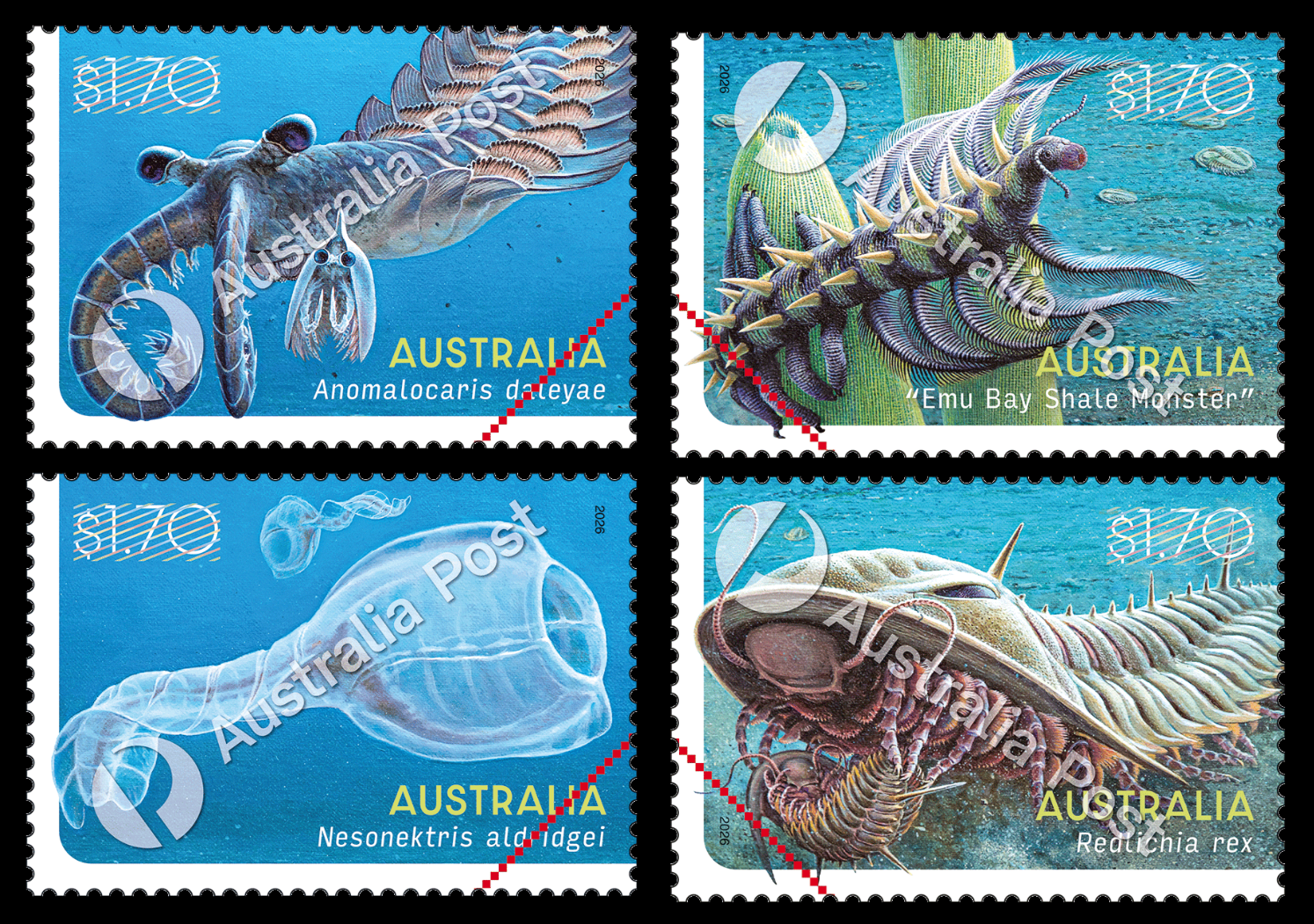
“South Australians are really lucky with all this wonderful fossil heritage from the Ediacara, to the megafauna and down to Emu Bay.
“Illustrating these stamps is useful for increasing the public profile for the scientific community.
“My stamps have proven very popular in the past and I’ve got my fingers crossed this time.”
The South Australian Museum also hosts a permanent exhibition on the Emu Bay fossil deposit.
For more information on the stamp set, visit Australia Post.


