.jpg)
It has been compared to the almighty Tyrannosaurus rex and was even named for the ‘king’.
A heavily-armoured tank that roamed the sea floor eating whatever it wanted – the product of an evolutionary arms race that produced the Cambrian ‘explosion’ of animal life some 540–520 million years ago.
Meet the giant trilobite Redlichia rex.
Rex (pictured above, ⓒ Australia Post 2026), which means king, grew up to 25 cm in length and was an arthropod with a hard external skeleton, not unlike the one in modern-day lobsters.
It is the largest trilobite found in the Cambrian of Australia, incredibly, in our own back yard in shale deposits at Emu Bay on Kangaroo Island.
South Australian Museum Senior Researcher and palaeontologist Diego García-Bellido leads the research team studying the Emu Bay Shale site.
.jpg)
The team’s work has led to breakthroughs in understanding the ecosystem of the Cambrian Period in which R. rex lived: on the seafloor of a small bay in about 60m of water.
The animals that emerged then were the ancestors of modern sponges (poriferans), bristle-worms (annelids), snails and cockles (molluscs), crustaceans (arthropods), sea-stars and sea-urchins (echinoderms), and the group to which people belong (chordates).
“Cambrian animals lived at a time when life on the planet was basically confined to aquatic environments,” Associate Professor García-Bellido said. “The continents were barren, and no plants or animals would successfully inhabit them until many tens of millions of years later.
“One of the most important novelties of this animal radiation was the appearance of predation, which in turn, drove the development of skeletons, shells and other hard structures for protection in a Cambrian ‘arms race’.
“Predators developed ‘weaponry’ such as grasping claws for attack, and their prey had to evolve defensive features such as spines and other forms of armour, or alternatively the ability to burrow or swim quickly to avoid being eaten.”
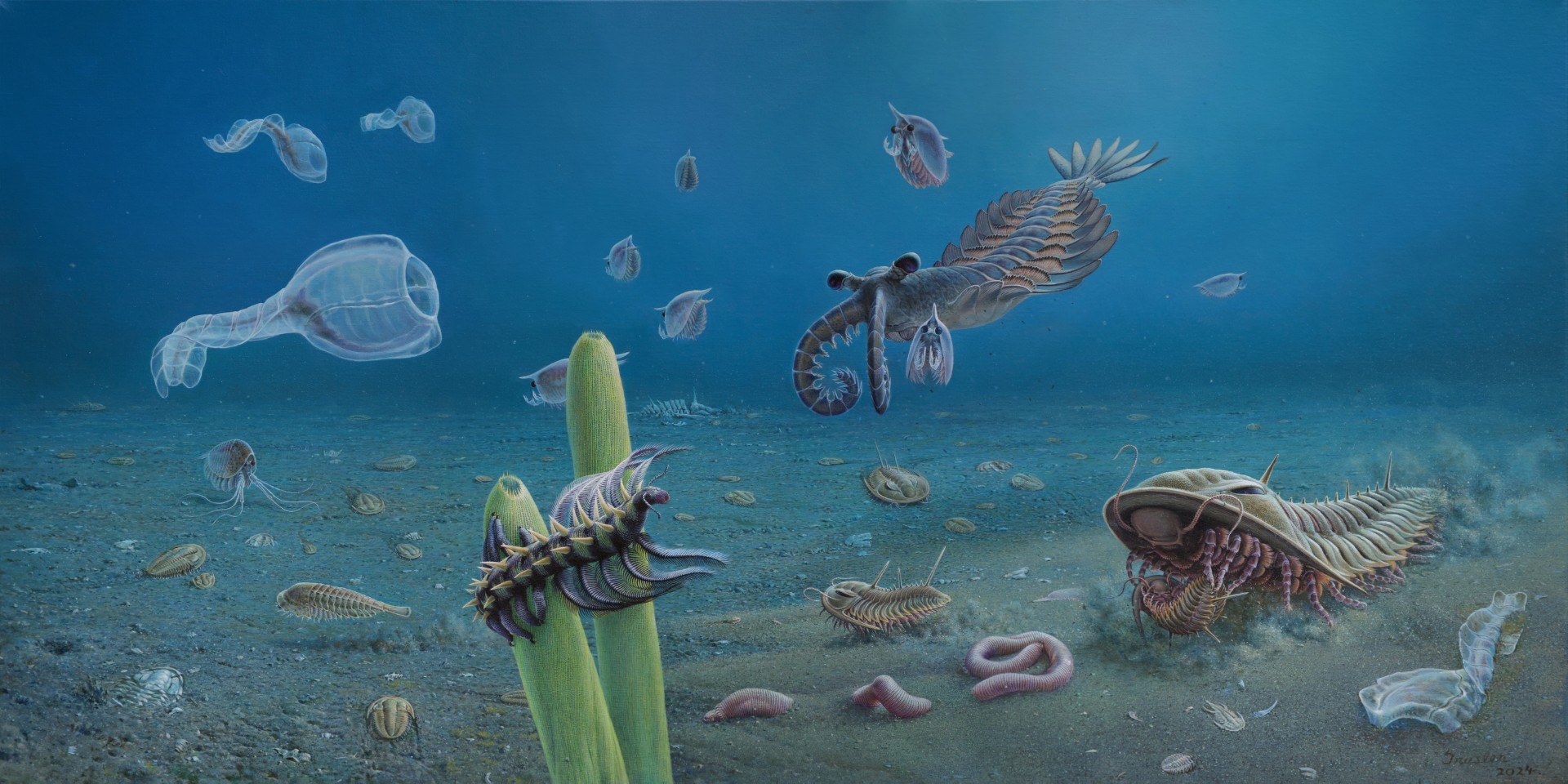
Dr García-Bellido said while most fossils are those from the body parts that do not decay easily, such as shells, some exceptional localities contain the fossilised remains of soft tissues.
That can include eyes, guts and muscles, which are rarely preserved.
“This is largely due to their rapid burial in a low oxygen environment, like what happened at Emu Bay,” he said. “The fossils found there on Kangaroo Island are the only window in the Southern Hemisphere we have for these extraordinary Cambrian creatures.”
The fossils of Emu Bay Shale are now so important, they’ve been depicted in a series of Australia Post stamps Creatures of the Palaeozoic, based on the artwork of renown scientific illustrator Peter Trusler.

Dr Trusler and Dr García-Bellido worked closely on the project, building the incredible images from the latest scientific research.
The artwork is also featured in display placed in the Museum’s foyer in February.
One of the favourites, of course, is the depiction of Redlichia rex.
It was first described as a new species in 2020, by Dr García-Bellido and colleagues, when it was recognised to be considerably different, and larger, than its close cousin Redlichia takooensis.
In the artwork, R.rex is captured preying on a R. takooensis.
There are only 50 known R. rex specimens, but that’s enough to show it had a well-mineralised exoskeleton with a line of spines along its back.
.jpg)
Fortunately, some of its soft tissue anatomy has also been preserved, like its antennae and pairs of biramous body appendages, each with a dorsal branch, which probably served as a gill, and a ventral branch for walking (leg).
R. rex’s legs were armed with two rows of spines, displaying an irregular saw-tooth pattern.
“These short, robust spines were used for crushing and shredding food,” Dr García-Bellido said, “making it a formidable predator capable of hunting and breaking animals with shells.
“It was probably the main producer of the large shell-bearing coprolites - or fossilised poo - and the exoskeletal injuries found in many Emu Bay Shale trilobites, including its own kind.
“That makes Redlichia rex one of the first animals to practice cannibalism.”
A habit that nowadays - more than half a billion years later - may be considered a little less than regal.
You can read more about Peter Trusler’s amazing Creatures of the Palaeozoic artwork on the Museum’s News page.
The South Australian Museum also hosts a permanent exhibition on the Emu Bay Shale fossil deposit.


