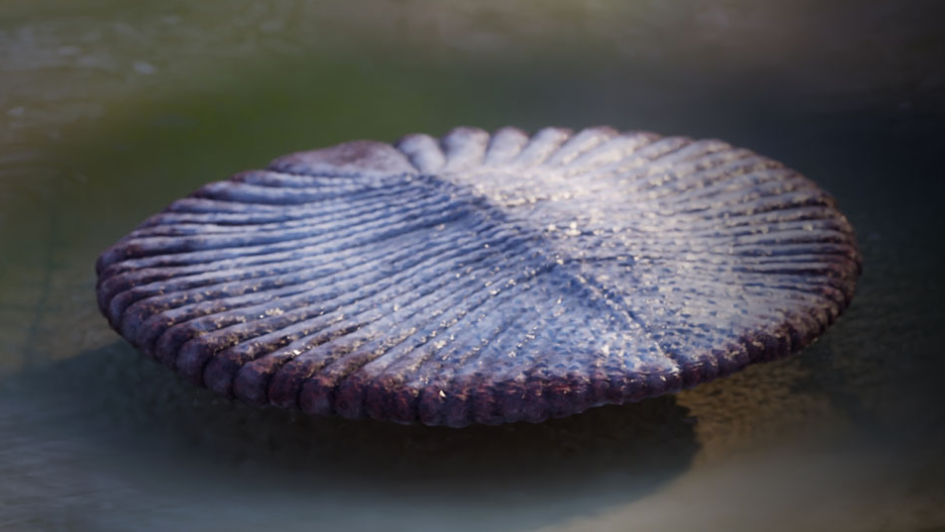
Picturing the burgeoning and mysterious lifeforms of the Ediacara can be difficult.
Given all that’s left of them are prints, flattened into the rock of the Flinders Ranges.
But a new educational resource is bringing the fossilised remains back to life in fabulous 3D, 550 million years after the now strange world disappeared into the sands of a shallow sea.
The South Australian Museum’s partner, the Flinders Ranges Ediacara Foundation (FREF), developed the online resource Discover the Ediacara Biota for students, scientists and the curious explorer.
The resource provides analysis and interactive tools, all informed by the latest research, much of it done by the South Australian Museum.
All you have to do is visit the FREF website – once there you can follow the links to learn about organisms such as Dickinsonia (above, and below), Funisia and Attenborites, and use your computer mouse to view and manipulate them in 3D.
South Australian Museum Director of Collections and Research Adam Moriarty said the 3D resource complemented the Museum’s research into the Ediacara.
The Museum also has an extensive exhibition of Ediacaran fossils.
“The Museum holds one of the world’s leading Ediacaran collections, and this new resource builds on that strength,” he said.
“It gives students and visitors another way to explore the organisms they see in the Ediacaran Gallery and understand the science behind them.”
The developer of the resource, Sam Haren, Creative Director at Sandpit, said the new educational website brings the story of the world’s earliest complex life to a global audience.
“The site focuses on four key Ediacaran organisms and the microbial mats that sustained them,” Sam said. “It allows visitors to explore animated seafloor environments, interactive 3D models, and insights into the pioneering paleontological work at Nilpena Ediacara National Park.
“It offers an accessible and visually rich resource that complements the on-site visitor experience while sharing the significance of South Australia’s ancient geological heritage with learners everywhere.”
Distinguished Professor Mary Droser from the University of California Riverside, who has worked extensively on the site in the Flinders Ranges with the South Australian Museum’s researchers, said visitation to the Nilpena Ediacara National Park was at a record high in 2025.
"This new website offers a resource for those who can’t visit Nilpena Ediacara National Park and those who visit and are looking for follow-up information,” she said.
Mary Lou Simpson, OAM, Chair of the Flinders Ranges Ediacara Foundation, said the Foundation is committed to the ongoing protection, visitor appreciation and understanding of the fossils at Nilpena Ediacara National Park.
“We have a particular focus on engaging with schools and science teachers and this new resource provides an amazing tool for us to foster this work,” she said.
To spend some time with the fossils from the comfort of your classroom or couch, visit the FREF website.


