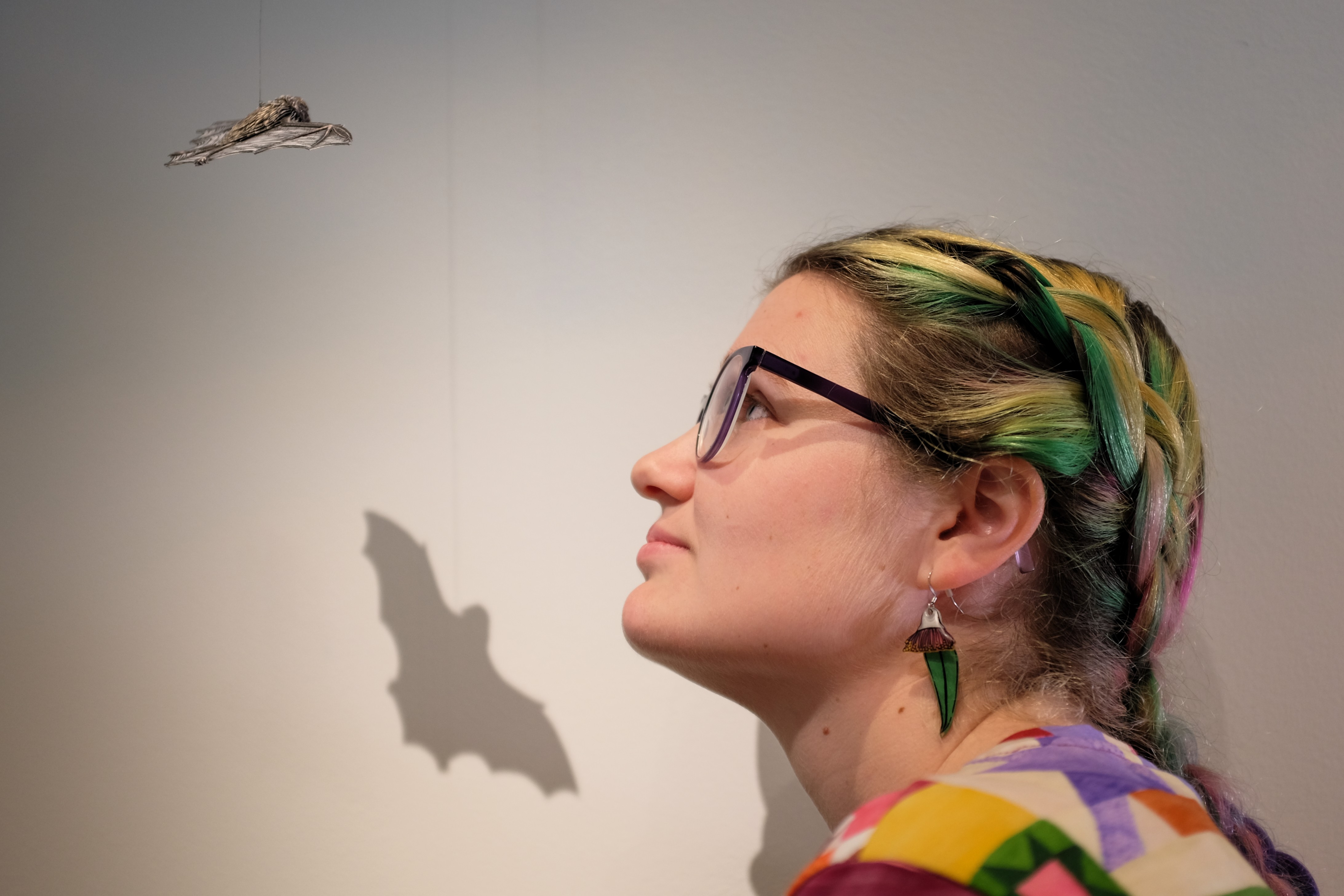
The tiny work of art could be easy to miss.
A miniscule bat, taking wing in a corner of the Waterhouse Natural Science Art Prize exhibition at the South Australian Museum.
But this linocut sculpture, crafted from the pages of a Grimms fairytale, speaks volumes about our changing world.
The subject is the extinct Christmas Island pipistrelle, whose call was last recorded in 2009 and has not been heard since.
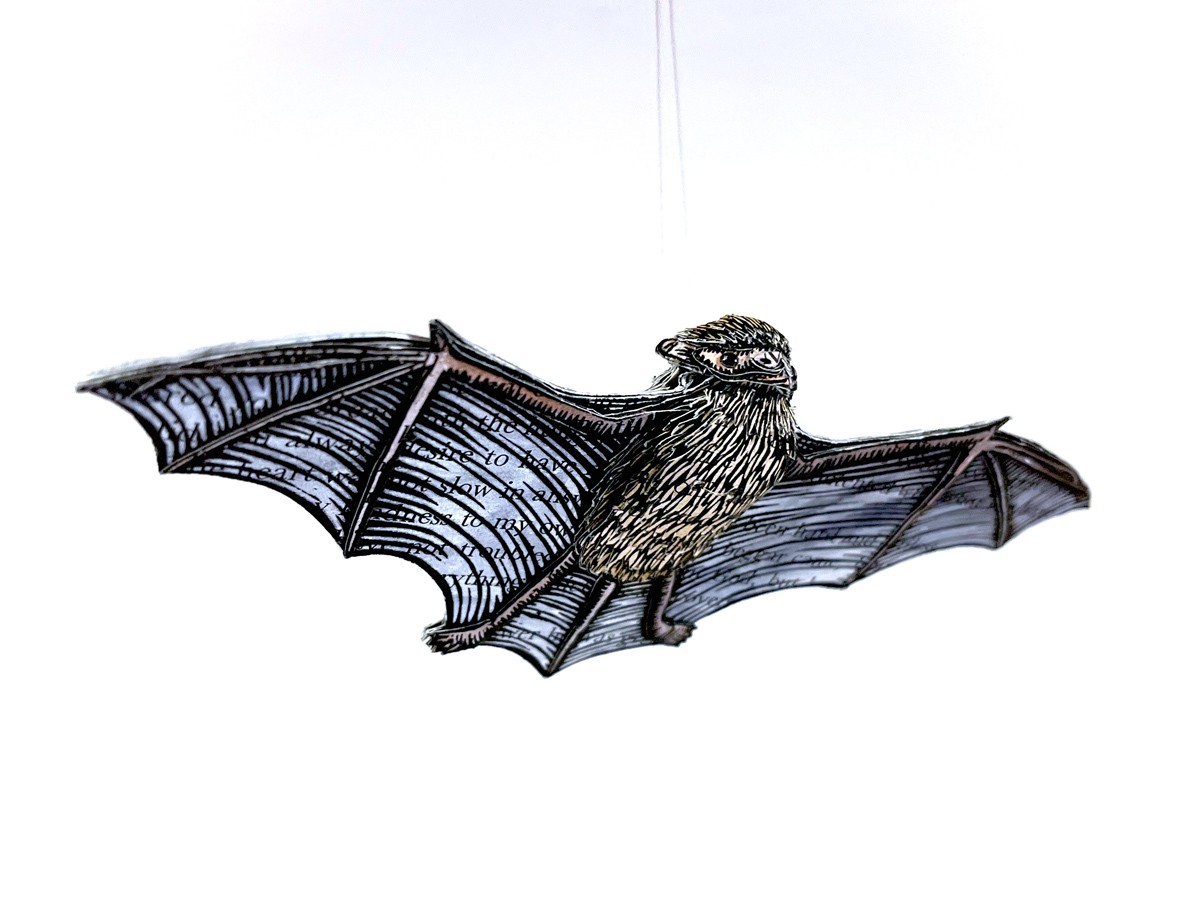
The sculpture by Shepparton print maker Kat Parker titled Discarded (Christmas Island Pipistrelle), was named winner of the Waterhouse’s Emerging Artist category last month. The category is sponsored by Hill Smith Art Advisory.
The win earned Kat $10,000 and she has now made the journey to Adelaide with her parents Anthony and Anne to see the exhibition.
“I’m mainly a printmaker,” she said, “which probably seems very odd when that’s a sculpture. But it’s about the repetition of print – you can create shapes from multiples of the one linocut.
“I have a series of works which focuses exclusively on extinct Australian animals, and extinct animals are really only brought to life through stories.
“I think it’s really important that we acknowledge what we have lost so we can understand the state of the environment. We can only learn from our mistakes.”
Kat, 27, at top with her winning Waterhouse entry, studied a Bachelor of Fine Art at RMIT and now works full time as an artist.
She was also named a finalist in the 2024 Waterhouse with another sculpture in her series: Discarded II (Bramble Cay melomys), which was also last seen in 2009.
Its extinction was caused by rising sea levels and increased severity and frequency of storms. It is the first known mammalian extinction directly attributed to human-induced climate change.

Kat said the story of the pipistrelle was also a tragic one.
Scientists were trying to capture the last surviving specimens for a captive breeding program when their calls went silent.
She credits the Waterhouse and the South Australian Museum for giving the two extinct animals a voice.
“It’s amazing,” she said of the competition and exhibition.“I think it’s incredible there’s an art prize like this, that merges art and science.
“It helps promote science which encourages public interest.”
So, what now for Kat?
“I want to continue on this series,” she said. “I did start last year making bigger works, like a bandicoot and things like that.
“I was definitely surprised my bat entry won – it’s so small it usually gets overlooked.”
See Kat’s artwork at the Waterhouse exhibition at the South Australian Museum until Sunday 19 July.


