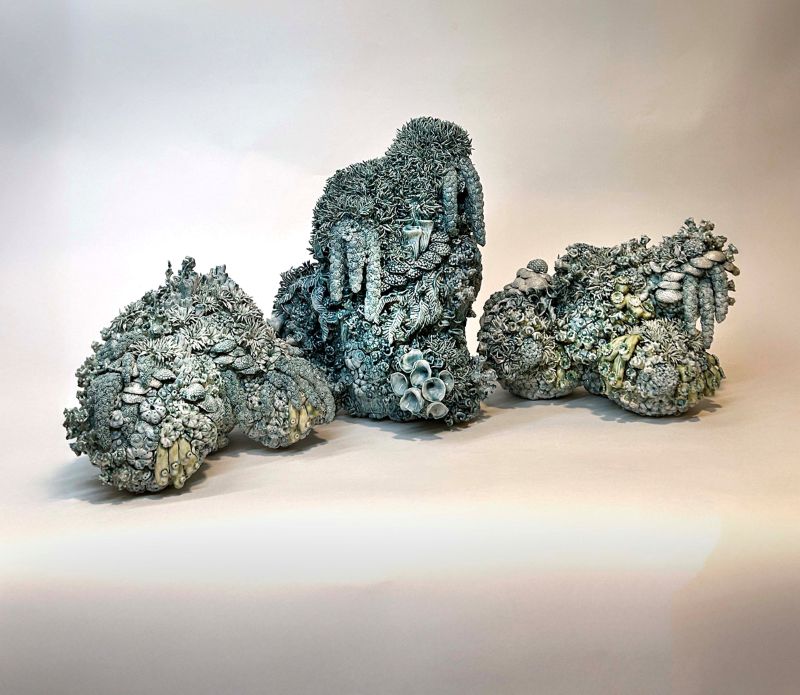
The Waterhouse Natural Science Art Prize features 74 artworks that engage with nature and the natural sciences. The exhibition runs once every two years and is open to artists working across all mediums including 2D, 3D, and digital works.
Works are displayed on walls, in glass display cabinets, and on open plinths. Some works are suspended from the ceiling, and one is laid flat on the floor. Works can be viewed from a seated or standing position.
The exhibition is located on the ground floor of the South Australian Museum and runs from 10 April – 19 July 2026.
The exhibition is open every day from 10:00am – 5:00pm, including public holidays and weekends.
The Waterhouse Natural Science Art Prize is a ticketed exhibition. Tickets can be purchased online or at the Museum on the day of your visit. The point of sale may change throughout the run to accommodate busy periods and other events at the Museum. You can find out where to buy tickets by asking at the main information desk on the ground floor.
You can buy tickets online here.
Ticket sales at the Museum are card only. The Museum is cashless for exhibition ticket sales.
Tickets are $15 adults, $12 concession, seniors and students. Free entry for South Australian Museum members and children aged 12 years and under.
The Museum is a member of the Companion Card scheme and offer complimentary admission to Companion Card holders to all ticketed events and exhibitions.
The rest of the Museum remains free to visit and does not require a ticket.
The entrance to the exhibition space is located on the western side on the foyer, near the red staircase. Entry is through automatic sliding doors. Tickets will be scanned by staff before you go in.
There is a gentle incline at the entrance to the exhibition, immediately after entering through the doors. The rest of the exhibition has flat, carpeted flooring.
Tickets are single entry, if you need to briefly exit, see staff for a pass out that allows for re-entry.
Once inside the exhibition, you are free to explore and move about in any direction. Many visitors move around in a clockwise direction, but this is not compulsory. There are some corners which may require you to double back, and these may be tighter for some larger power chairs to navigate.
All artworks in the exhibition are for sale. Prices are listed on the text next to each artwork. If you would like to inquire about purchasing an artwork, speak to staff at the front desk.
A red dot is placed on the Information Plaques when an artwork is sold and no longer available.
Visitors can vote for their favourite work using tablets located near the doors of the exhibition. Voting is optional. You can ask staff for assistance if required.
There will not always be staff inside the exhibition space. If you need assistance, you can speak to staff on the front desk. If you need to leave the exhibition to ask staff for assistance, you will be able to go back in.
Morning, weekends, and school holidays are usually the busiest times for visiting the exhibition. Late afternoons, especially on weekdays, are often quieter. Please note that tickets cannot be purchased at the door after 4:30pm, but once inside you are welcome to stay until Museum closes at 5:00pm.
An audio described trail is available for this exhibition, and can be accessed by scanning a QR codes with your own device. The trail starts with an introduction and room overview accessed via a QR code located to the left of the exhibition doors. From there the trail includes 9 artworks which include the emerging and open category winners. For all the wall mounted artworks the QR code is to the left under the wall label. On the 3D artworks, the code in on the top of the plinth, facing upwards towards the ceiling. The descriptions have been prepared by Access2Arts and will follow a clockwise path around the exhibition.
The QR codes can be scanned using any smartphone, and also have NaviLens enhancements, which provide additional audio feedback to people using the NaviLens app. Each QR code also as a braille tactile indicator to assist users to understand the location and size of the code.
The audio descriptions can also be found on our Access and Inclusion page and can be accessed at any time.
.jpg)
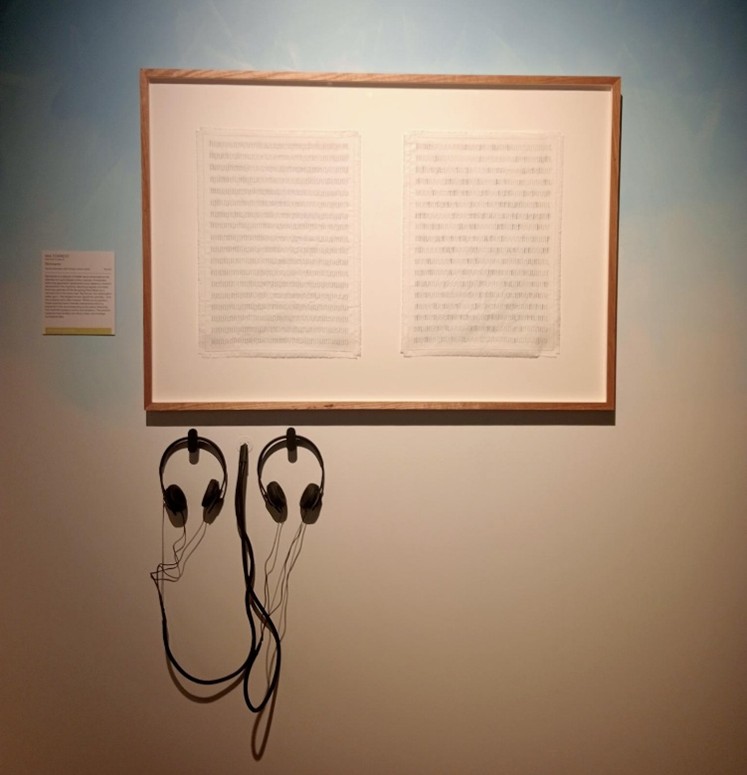
There are a few digital artworks that include sound elements. Two of these have headphones which you are free to use to listen to the audio elements. The headphones are located on hooks under the visual component of the works, and there are two sets for each work. Some works have audio which can be heard in the surrounding area. Most of the audio elements are gentle ambient sounds from nature. Remnants by Mia Forrest plays a deep pulsing buzzing sound. Which can be listened to through headphones. All works with audio can be enjoyed without the sound.
The exhibition is brightly lit and does not include any flashing, strobing or other lighting effects.
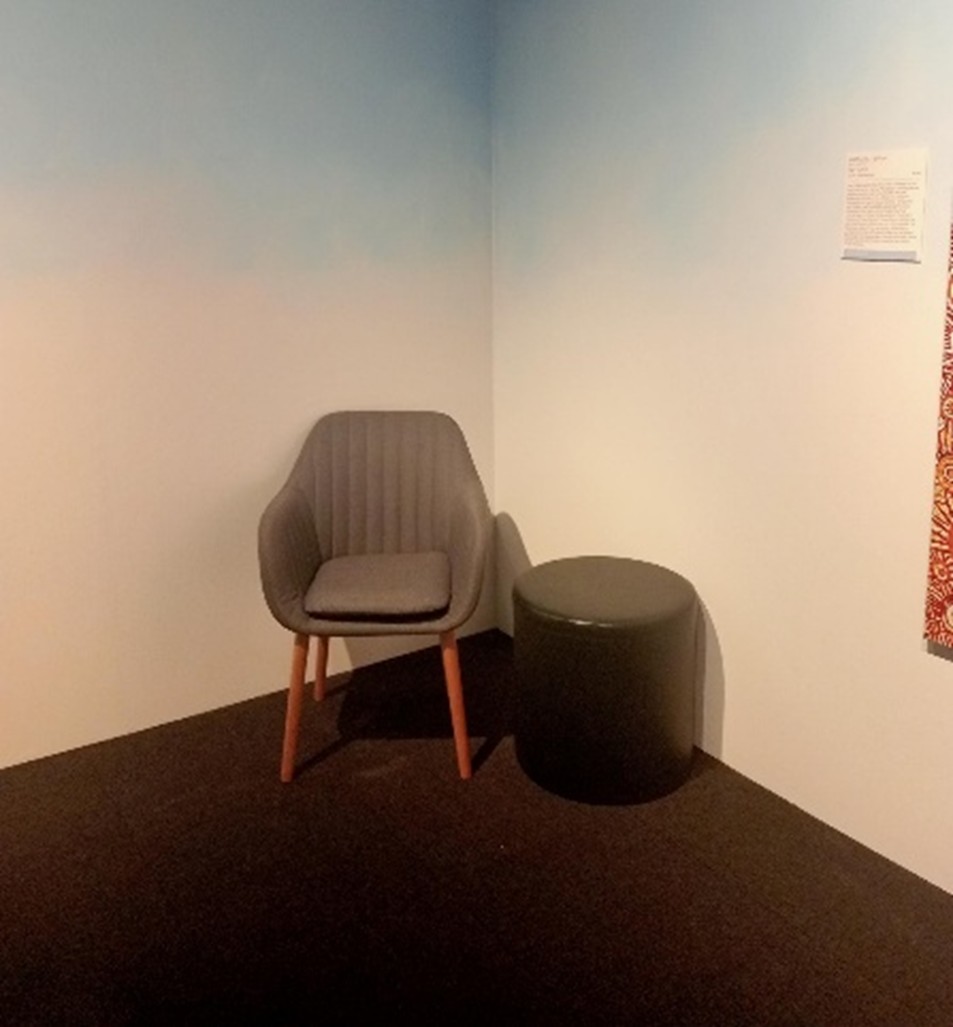
There is seating available throughout the exhibition. The seating is a combination of individual ottoman-style stools, and chairs with backs and arms. Some of the ottomans are dark and sit on dark carpet, which could be hard to see for some visitors with low vision. The walkers available for loan at the front desk can also be used as seats.
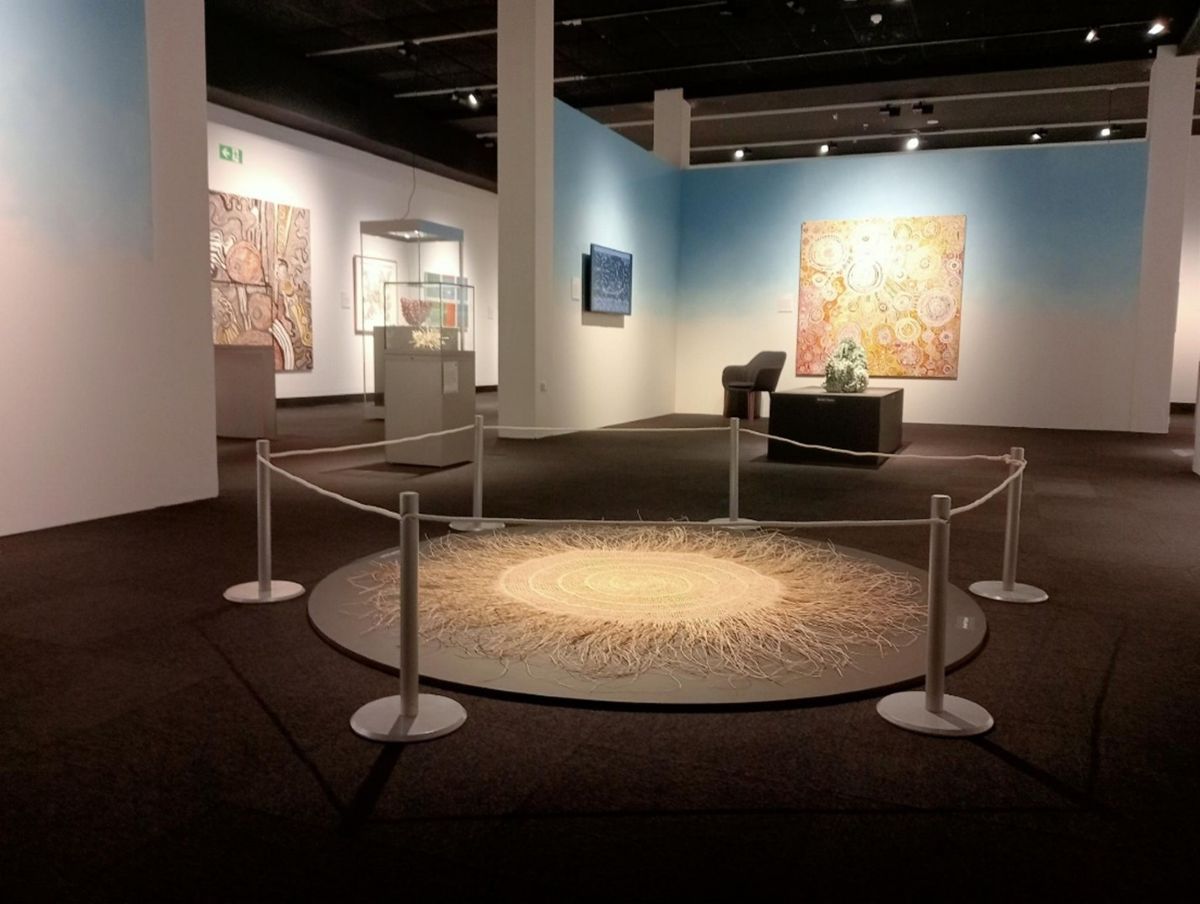
The work Nganiyal (woven mat) by Daphne Banyawarra isdisplayed on the floor on a low plinth, which is just a couple of centimetres high. It is surrounded by a low rope supported by six posts which are approximately 30cm high.
The plinth is dark grey and a similar colour to the carpet, so it may be difficult for some visitors to see. The work is a light-coloured woven mat, made from natural pandanus and it stands out against the dark background. The plinth is circular and about 1.5m in diameter.
This work is located in the centre of the exhibition space and is under a spotlight, but may not be obvious to visitors with low vision.
There are several public transport options when travelling to the Museum.
Train: The Museum is a 10-minute walk from the Adelaide Railway Station, which is also on North Terrace.
Tram: The closest tram stop is Art Gallery, which is out the front of the Museum on North Terrace on the Botanic/Entertainment centre line. You can also walk from Rudle Mall or North Terrace on the Glenelg line.
Bus: There are a number of bus stops on North Terrace and King William Street as well as other nearby locations in the city.
Check Adelaide Metro for the most up to date timetables and information.
There is one accessible car park at the rear of the Museum, available on a first-come, first-served basis. Entry to the car park is through the boom gate on Morgan Thomas Lane, off Kintore Avenue. Please ensure your valid disability parking permit is displayed.
If the park is already in use, visitors can be dropped off at the Museum’s rear door.
Alternative accessible parking is also available at:
- Wilson Parking, North Terrace (opposite the Museum)
- U-Park, Gawler Place
- Paid ticketed street parking on Kintore Ave
The exhibition is stair-free, including at the entrance, and most mobility devices will be able to navigate the spaces.
Wheelchairs and walkers are available for loan to use in the Museum. To access this service, ask staff on arrival. Photo ID will be required to borrow a walker or wheelchair. The wheelchairs are regularadult sized, and the walkers are XL adult sized. These devices are loaned on afirst-come, first-served basis.
The Museum will have our sensory backpack available for free loan. To borrow a backpack, ask staff atthe front desk. Each backpack contains a pair of ear defenders, a soft toy, a fidget toy, and some communication cards.
You are welcome to bring your own sensory aids to make your experience more comfortable.
Accredited assistance dogs are welcome at the Museum. Information about the criteria for accredited animals can be found at the Dog and Cat Management Board.
No food is allowed in the exhibition space. Food can only be consumed in the foyer on the ground floor. Water may be consumed anywhere in the Museum, including the exhibition. Breastfeeding and bottle-feeding of babies is welcome everywhere in the Museum. The Museum Café is open daily from 10:00am and closes between 3:00pm-4:00pm.
Toilets are located on the ground floor at the eastern end of the World Mammals Gallery.
There are 2 accessible toilets, and male and female bathrooms.
The accessible toilets do not include adult changing facilities or hoists.
The male and female bathrooms have hand dryers built intothe taps. The taps work by motion sensor and activate when you put your hands under the spout. The hand dryers are activated by moving your hands to the side. These can be very loud, especially when multiple dryers are being used at once. People who are sensitive to sounds may prefer to use the accessible bathrooms, where there is only one hand dryer, which is mounted on the wall.
There is a Parents Room on Level 1 near the southern lift. It includes a microwave, seating, a toilet and baby change facilities.
If you have any other questions, please contact us at contact@samuseum.sa.gov.au
We will be very happy to help.


